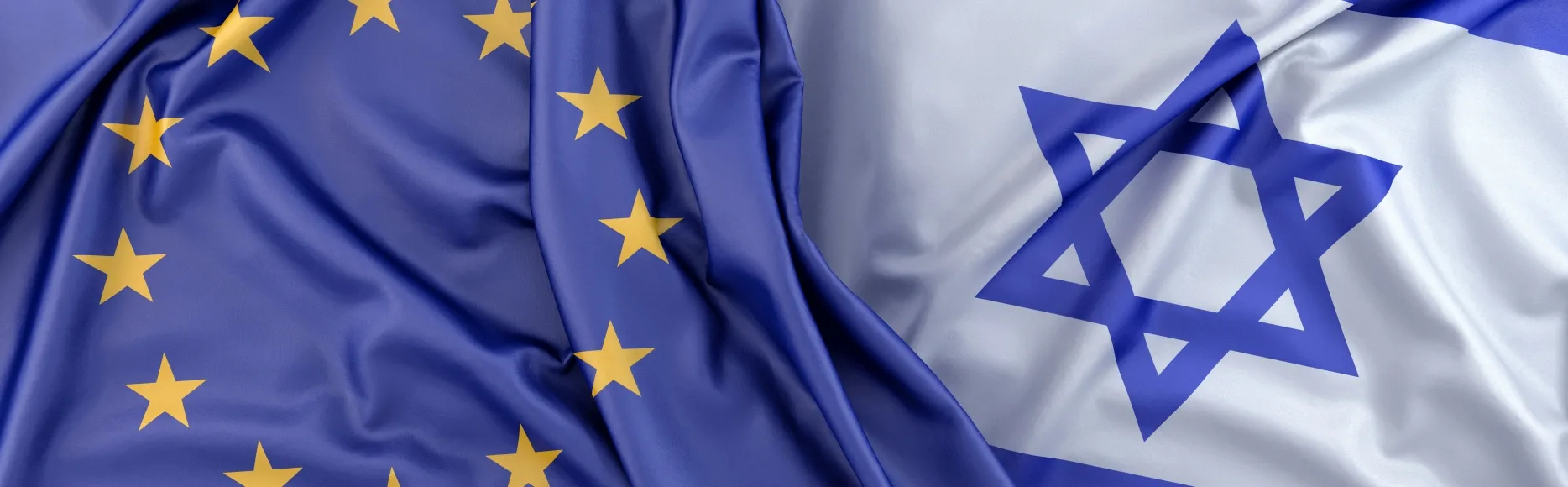
Three German federal states (Brandenburg, Hesse and Lower Saxony) are jointly campaigning to ensure that Israel continues to participate fully in the forthcoming 10th EU Framework Programme for Research and Innovation (2028–2034). On 16 October 2026, the federal states tabled a corresponding motion for a resolution in the Bundesrat. This calls on the Federal Government to advocate strongly for the full continuation of Israel’s association.
In July 2025, the European Commission proposed to the Council that Israel’s participation in the EIC Accelerator – a funding stream under the current Horizon Europe research framework programme – should be suspended. The proposal has not yet been taken forward, but the debate over Israel’s future role in European research programmes continues.
Views from the Federal States
Brandenburg’s Minister for Science, Dr Manja Schüle, says:
“A suspension penalises institutions for decisions they did not make. Politics may fund science, but it must stay out of it when it comes to topics, methods and results. Furthermore, research is not a national product. Knowledge is created between people, not within borders. A European framework programme is designed precisely for this purpose, and a suspension not only prevents future collaboration – it disrupts ongoing collaboration. In doing so, it affects institutions that are independent. Universities everywhere are places of freedom and critical thinking, not because they are political, but because contradiction is part of their methodology. This applies to Israel’s universities just as much as to ours. And a single funding stream is not a world unto itself: many start-ups are spin-offs from universities; their journey begins in a laboratory – often as part of a jointly funded European project. Anyone who cuts off the end of this chain therefore also cuts off its beginning.”
Hesse’s Minister for Science, Timon Gremmels, emphasises:
“Scientific cooperation has its own intrinsic value. It fosters encounters, enables shared insights and opens up spaces for exchange and understanding. It thrives on people of different backgrounds, different perspectives and sometimes even different political convictions working together. We should distinguish between a government’s political positions and scientific cooperation with its universities and research institutions – and not sever scientific ties. This applies in particular to joint projects in the humanities and social sciences, such as research into democracy. In my view, the EU Research Framework Programme is the wrong place for politicisation. Any suspension could pave the way for further and ultimately even more far-reaching measures. Particularly at a time when international relations are becoming more difficult and complex, we need places where people can continue to engage in dialogue across borders and build trust through joint projects. Universities and research institutions are such places – including, and especially, in Israel.”
Falko Mohrs, Minister for Science in Lower Saxony, commented as follows:
“Lower Saxony is firmly opposed to any exclusion of the Israeli scientific community. For almost 50 years, our state has been promoting scientific and personal exchange between Lower Saxony and Israel through research collaborations. A vibrant partnership has emerged from this historical responsibility, one that brings together science, innovation and exchange. Particularly in the wake of the horrific terrorist attacks on 7 October, it was important for us to send a clear signal and to further expand our cooperation with Israel. Research institutions and businesses have been benefiting significantly from this cooperation for years. Israel is one of the world’s leading centres for science and innovation. Anyone seeking to exclude Israeli institutions from European research programmes, or to restrict their participation, for political or anti-Israel reasons, is not only undermining long-standing partnerships but also weakening Europe’s innovative capacity and competitiveness. For Lower Saxony, one thing is certain: this partnership is of great importance to us and will remain an integral part of our international scientific cooperation in the future.”
Close cooperation with Israeli partners
IIsrael has participated continuously in the European Framework Programmes for Research since 1996. This collaboration has led to a large number of joint research projects. Israeli universities and research institutions possess outstanding scientific and technological expertise and are particularly strong in strategically important fields such as artificial intelligence, quantum research, biotechnology and health research.
In the 8th EU Research Framework Programme “Horizon 2020” alone, Israeli institutions were involved in 1,694 projects, securing a total of 1.3 billion euros in funding. This represents 4.8 per cent of all projects (around 35,000) whilst accounting for just 1.6 per cent of total funding (79.4 billion euros). This cooperation is also of great significance for Hesse and Brandenburg. Many universities and research institutions in both states work closely with Israeli partners – for example, institutes within the Helmholtz, Leibniz and Max Planck research networks, the Moses Mendelssohn Centre, the University of Potsdam and the Berlin-Brandenburg Economic Development Agency; numerous joint projects are supported by EU funding.
Sources (in German): State of Brandenburg; Science Hesse; State Chancellory of Lower Saxony